Text
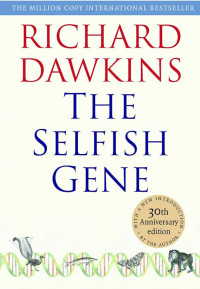
THE SELFISH GENE
At almost the same time, W.D. Hamilton raised another question about how natural selection acts. He pointed out that if a gene were to cause its possessor to sacrifice its life in order to save the lives of several relatives, there might be more copies of the gene present afterwards than if the sacrifice had not been made, because relatives might carry copies of the gene inherited from a common ancestor. The suggestion has obvious relevance for the evolution of social behaviour. To model the process quantitatively, Hamilton introduced the concept of ‘inclusive fitness’. To understand this, you must first appreciate that scientists use the word ‘fitness’, as they do ‘force’, in a technical sense only loosely related to its colloquial meaning. ‘Fitness’ is a property of a ‘genotype’ – that is, of individuals of a particular genetic constitution. Crudely, it is the expected number of offspring produced by individuals of a given genotype in a given environment. Hamilton saw that to use fitness in this sense could lead to wrong predictions about how the frequencies of genes in populations would change – i.e. about evolution. He therefore replaced this classical fitness by ‘inclusive fitness’, which includes, not only an individual’s own offspring, but any additional offspring raised by relatives with the help of that individual, appropriately scaled by the degree of relationship: for example, if I (or more precisely, people with a genotype like mine) help my sister to raise a child she would not otherwise have, that raises my inclusive fitness by one half. It has since become a rule of thumb among students of social behaviour to say that animals will behave so as to maximise their inclusive fitness.
Dawkins, while acknowledging the debt we owe to Hamilton, suggests that he erred in making a last-ditch attempt to retain the concept of fitness, and that he would have been wiser to adopt a full-blooded ‘gene’s eye’ view of evolution. He urges us to recognise the fundamental distinction between ‘replicators’ – entities whose precise structure is replicated in the process of reproduction – and ‘vehicles’: entities which are mortal and which are not replicated, but whose properties are influenced by replicators. The main replicators with which we are familiar are nucleic acid molecules – typically DNA molecules – of which genes and chromosomes are composed. Typical vehicles are the bodies of dogs, fruitflies and people. Suppose, then, that we observe a structure such as the eye, which is manifestly adapted for seeing. We might reasonably ask for whose benefit the eye has evolved. The only reasonable answer, Dawkins suggests, is that it has evolved for the benefit of the replicators responsible for its development. It is, he says, foolish to argue about whether some behaviour pattern has evolved for the benefit of the individual or of the group, since both individual and the group are vehicles. Although, like me, he greatly prefers individual advantage to group advantage as an explanation, he would prefer to think only of replicator advantage
Ketersediaan
Informasi Detail
- Judul Seri
-
-
- No. Panggil
-
576.8 RIC t
- Penerbit
- New York : Oxford University Press., 1976
- Deskripsi Fisik
-
xxii + 360 hlm.; ilus.; 20.5 cm
- Bahasa
-
English
- ISBN/ISSN
-
9780199291144
- Klasifikasi
-
576.8
- Tipe Isi
-
text
- Tipe Media
-
-
- Tipe Pembawa
-
-
- Edisi
-
30th anniversary edition 2006
- Subjek
- Info Detail Spesifik
-
-
- Pernyataan Tanggungjawab
-
-
Versi lain/terkait
Tidak tersedia versi lain
Lampiran Berkas
Komentar
Anda harus masuk sebelum memberikan komentar
 Karya Umum
  Filsafat
  Agama
Agama  Ilmu-ilmu Sosial
  Bahasa
  Ilmu-ilmu Murni
  Ilmu-ilmu Terapan
  Kesenian, Hiburan, dan Olahraga
  Kesusastraan
  Geografi dan Sejarah